Freshdesk alternatives for AI customer service software in 2026
If you’re frustrated with Freshdesk’s AI costs, configuration limitations, and cloud-only deployment, it’s time to start looking at other help desks.

Freshdesk, a product of Freshworks, is a widely used help desk platform that has found a strong foothold with SMBs and startups. It’s a good generalist platform for many customer support teams, bringing structure to ticketing management and SLA tracking. It also offers AI features–including sentiment analysis, writing assistance, and ticket summarization–that are competitive with several other major help desk providers.
However, Freshdesk has its limitations, especially as teams grow and support complexity increases. Common friction points cited in customer reviews include:
- Interface navigation challenges
- Unpredictable AI costs
- A poor customer service experience
- Lack of data residency control
- Reporting limitations
The help desk your team chooses will affect agent productivity, ticket resolution times, total cost of ownership, and the employee or customer experience. Investing in a platform that your team outgrows after a few years also leads to potential disruption and switching costs, so it’s important to choose a solution that is flexible enough to continue meeting your needs as your team, ticket volume, and support complexity grow.
Below, we’re taking a closer look at Freshdesk and several top alternatives so you can weigh your options. We’re covering:
- Why teams look beyond Freshdesk
- What to look for in a Freshdesk alternative
- How the top Freshdesk competitors compare
- Why Deskpro is a strong alternative
Why teams look for Freshdesk alternatives
While Freshdesk remains a popular help desk pick for small and medium businesses, recent product reviews reveal several common reasons customers are dissatisfied and thinking of switching (or have already taken the leap).
- Interface frustration. While some reviews praise Freshdesk for having a “straightforward” and “approachable” interface, others note that some areas of the interface feel clunky and require unnecessary clicks. The need to toggle between tabs for tickets from different channels (such as voice and chat) is a frequently-cited point of friction, as is the inability to customize the ticket sidebar and hide irrelevant fields. Deskpro customer St. Wilfrid’s migrated off Freshdesk in part because the complexity of the interface was creating a poor agent experience.
- Unpredictable AI costs. Freshdesk offers its Freddy AI suite with all of its plans, but only the first 500 sessions (tasks that use AI tokens) per month are included, with additional session-based costs accruing once you go over that limit. This means customers using advanced AI features often find their monthly bill doubling or tripling because they exceed the AI session limit in just a few days.
- Data sovereignty and compliance requirements. Freshdesk is a cloud-only solution, meaning it’s not an option for organizations that have strict data residency or compliance requirements and must deploy their help desk on-premise or in a sovereign cloud, regional private cloud, or VPC.
- Reporting limitations. Customer reviews frequently note that the standard reporting in Freshdesk feels rigid and limited, and that customizing reports and integrating CRM data with Freshdesk requires an upgrade to the Enterprise tier.
- Poor customer service experience. A common trend across dissatisfied customer reviews is that Freshworks offers great support during the sales and onboarding process but that responsiveness drops off significantly after that. Some reviewers mention finding it difficult to reach a human agent, and that the human agents they do reach lack deep technical knowledge of the product. Deskpro customer AbilityNet switched from Freshdesk in part because they felt the frequent turnover of their Freshdesk account managers was creating a disruptive experience.
What to look for in the best Freshdesk alternatives
Choosing the right Freshdesk alternative or replacement for your team requires looking for more than just feature parity. You’ll need to look at how each solution approaches omnichannel ticket management, complex workflow customization, and internal vs. external support use cases. You need a help desk that aligns with the way your team works now but can also adapt as you grow (e.g., Will it work across multiple departments? Can you get granular with the permissions as roles and teams change?).
If you’re in a highly regulated industry, you’ll also need to factor in compliance requirements. It doesn’t matter how great the help desk features are if your security or compliance teams won’t let you deploy the solution. Factors to consider in regulated environments include available help desk deployment models (e.g., on-premise vs. cloud-only) and the ability to use AI models your organization has already vetted.
While your exact help desk needs will depend on your organization, here are some of the criteria our customers frequently mention:
- Advanced ticket management and SLA tracking
- Omnichannel support (email, chat, voice, social, forms)
- AI-powered ticket triage and agent assistance
- Automated workflows with deep configuration flexibility
- Customizable help center or knowledge base
- Reporting and analytics dashboards
- Role-based access control
- Internal and external support capabilities in one platform
- Flexible deployment (cloud, on-premise, sovereign cloud, private cloud, VPC)
- Transparent pricing (no surprise add-ons)
Best Freshdesk alternatives in 2026 (compared)
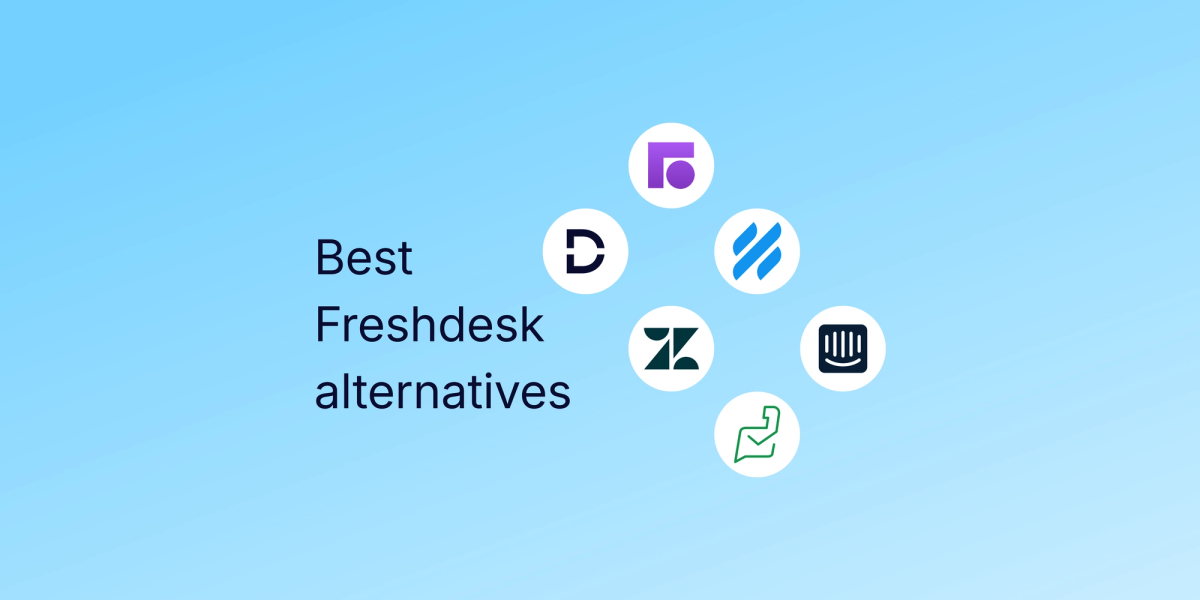
The help desk market is crowded, and it can be hard to know where to start your search. We’re here to provide an overview of six of the most popular Freshdesk alternatives. We’ve researched and evaluated each solution based on criteria including core ticket management capabilities, workflow customization, use of AI, deployment flexibility, and key use cases.
Deskpro
Deskpro is the industry leader in deployment flexibility, making it a top choice for organizations with strict security, compliance, and data residency requirements. While Freshdesk is only available as a public cloud-based solution, Deskpro can be hosted in a public cloud, regional private cloud, sovereign cloud, VPC, or on-premise. Customers can also choose the LLMs they want to power Deskpro’s AI features, enabling them to choose self-hosted or pre-vetted AI models that keep data under their organization’s control. For many support teams that have been blocked from using AI due to security concerns, Deskpro Private is their first opportunity to use AI productivity features like intelligent ticket routing, suggested responses, and ticket summarization.
Beyond its deployment flexibility and bring-your-own-AI model, Deskpro is known for its high level of workflow customization, which allows support teams to set up complex, multi-step automations that help them work more efficiently. Ticket management and SLA features also give users a high degree of control. For example, SLAs can be applied based on any ticket property, and multi-stage SLAs track every interaction through to resolution.
Additionally, Deskpro offers a transparent, all-inclusive pricing model without hidden fees for AI usage or feature add-ons.
Strengths:
- Deployment flexibility
- Bring-your-own-AI model
- Full data control
- Advanced workflow automation and SLAs
- Deep feature set included in standard pricing (no surprise add-ons)
Limitations:
- Less mainstream brand visibility than Freshdesk
- Potential learning curve due to level of customizability
- Advanced features may require implementation services
Zendesk
As the biggest player in the help desk market, Zendesk frequently goes up against Freshdesk in vendor evaluations. While Freshdesk is built primarily for SMBs, Zendesk’s foundation is structured ticketing at scale, and it works best for larger teams that need process, control, and advanced reporting. It offers a robust omnichannel workspace and a marketplace with 1500+ third-party integrations.
Zendesk’s AI features include chatbots, generative replies, and automated resolution reporting, available from the Suite Team tier and above. However, advanced AI features and data protection capabilities are gated behind higher-tier plans and add-ons that can significantly increase the total cost of ownership. And like Freshdesk, Zendesk is a cloud-only solution, which rules it out for organizations with strict data residency or compliance requirements.
Strengths:
- True omnichannel support across email, chat, voice, and social
- Customizable dashboards and advanced reporting
- Large integration ecosystem
- Well-established platform with a large user community
Limitations:
- Cloud-only deployment
- Costs escalate with add-ons
- No bring-your-own AI option
- Mixed customer reviews on support quality
Fin by Intercom
Intercom has deliberately repositioned itself away from traditional help desk software to what it calls an “AI-first customer service platform,” with its AI agent Fin as the centerpiece of that strategy. Fin by Intercom is built for teams that want to deflect the majority of support interactions to an autonomous chatbot. Fin draws on knowledge base content to inform its responses and has received generally positive reviews for its ability to handle tasks like refunds, transaction disputes, and technical troubleshooting.
This AI chat-based approach works best for B2C and SaaS companies that primarily use chat for support, but it’s less of a natural fit for teams that need a full-featured help desk. While Intercom offers SLA tracking, it’s optimized for real-time chat rather than the kind of structured, long-term ticket management that email-heavy or enterprise support teams need. Reporting depth and workflow customization also lag behind dedicated help desk platforms. And Intercom’s pricing model–which charges per AI resolution on top of seat costs–can lead to unpredictable monthly bills, especially at higher volumes.
Strengths:
- Reports industry-leading AI deflection rates with Fin
- Proactive outbound messaging and customer engagement tools
- Visual workflow builder for self-service routing
- Strong fit for in-app and mobile support experiences
Limitations:
- Limited depth of SLA and ticket management capabilities
- Basic reporting compared to other major competitors
- Unpredictable cost due to per-resolution AI pricing
- Cloud-only deployment
- Weaker fit for email-heavy or enterprise support use cases
Zoho Desk
Zoho Desk is a popular Freshdesk alternative for budget-conscious buyers and teams already working in the Zoho ecosystem. It offers a lot of the same core functionality as Freshdesk but at a lower price point, making it an appealing option for SMBs. Its native integration with Zoho CRM is also a selling point, giving teams a unified view of customer interactions across sales and support.
Zoho Desk offers workflow customization through Blueprint, a drag-and-drop builder that lets support teams map out processes and put guardrails in place. AI capabilities are powered by Zia, Zoho's proprietary AI, which handles ticket tag prediction, negative sentiment alerts, and a basic chatbot. These features are useful for surfacing context and flagging issues, but they're less autonomous than what Intercom's Fin offers, and the platform's SLA management, while solid, lacks the granularity available in Deskpro or Zendesk.
Strengths:
- Budget-friendly entry-level pricing
- Native integration with Zoho CRM
- Intuitive workflow building with Blueprint
- Strong mobile app experience for agents
Limitations:
- Interface can feel cluttered and dated
- AI capabilities are more basic than many competitors
- Limited flexibility in SLA management
- Cloud-only deployment
Help Scout
Help Scout positions itself as a relationship-driven alternative to enterprise help desk platforms. Their ticket management relies on intuitive folders and tags rather than complex status hierarchies, and workflow automation uses simple "If/Then" logic that most agents can configure in minutes. The AI features–primarily AI Drafts and conversation summaries–are designed to help agents work more efficiently rather than replacing them. For smaller e-commerce brands and startups with a focus on customer relationships, Help Scout is frequently a top choice.
However, organizations that need more structured ticket management, deep workflow customization, and enterprise-grade security may experience friction with Help Scout. There’s no Round Robin ticket routing, multi-brand management is limited, and the automation engine lacks the multi-stage depth of more enterprise-oriented platforms. Help Scout is also cloud-only, meaning it won’t meet the security or data residency requirements of highly regulated industries. For teams that expect to scale into complex support operations, Help Scout may become a constraint.
Strengths:
- Simplistic and clean UX
- Simple “if/then” workflow logic that’s fast to configure
- Human-centric email experience vs. traditional ticketing interface
- Positive customer support reputation
Limitations:
- Cloud-only deployment
- Lack of workflow automation depth
- No Round Robin routing or advanced ticket assignment rules
- Limited multi-brand management capabilities
Front
Front is a help desk built around collaborative support rather than a traditional ticket ownership model. Real-time collaboration features like response co-drafting, internal comments, and @mentions make Front a solid choice for high-touch support teams that often need to loop in subject matter experts from across the organization. Companies that find Freshdesk's siloed ticket model too rigid frequently evaluate Front as an alternative.
Front offers a unified conversation view, tracking response commitments through "Reply Time Goals" that trigger automated alerts or reassignments when a thread sits idle too long. Its visual "If/Then" automation engine can route incoming messages based on sender, keywords, or live CRM data, and it's particularly strong at load balancing–distributing message volume across agents. AI features include Autopilot (an autonomous chatbot), Copilot (to assist agents), and predictive CSAT scoring. The trade-off is cost: while Front’s entry-tier plan is competitive with others on the market, advanced AI features and automation capabilities are gated behind higher-tier plans, increasing the total cost of ownership.
Strengths:
- Robust collaboration features
- Strong load balancing and CRM-based routing
- Intuitive interface
- Unified conversation view
Limitations:
- Advanced AI and automation only available with higher-price plans
- Cloud-only deployment
- Less suited for IT service desk workflows
- Collaboration-first design may not meet the needs of high-volume support teams
Freshdesk vs. enterprise help desk platforms: Key differences
Freshworks positions Freshdesk as an SMB-friendly, easy-to-use help desk. And for small- to mid-sized businesses, there’s a lot to like, from its initial simplicity to its administrative ease. However, the qualities that make it a strong fit for SMBs can become downsides for enterprises or growing teams with complex support needs.
When compared to help desks that are built for enterprises, Freshdesk requires its users to make several tradeoffs:
- Simplicity vs. flexibility. Freshdesk’s intuitive setup is good for small teams that need to get up and running quickly, but that simplicity comes at the cost of advanced configurability. Reviewers frequently mention the inability to customize the ticket sidebar, hide irrelevant fields, or tailor the interface to complex workflows.
- Pre-built features vs. customization depth. Freshdesk offers a solid out-of-the-box feature set, but teams with more sophisticated needs often hit a ceiling–particularly around SLA configuration, reporting, and automation logic.
- SMB pricing vs. enterprise scalability. Freshdesk's base pricing looks attractive at smaller scale, but costs can escalate quickly as teams grow, especially when AI, advanced reporting, and CRM integrations enter the picture.
- Customer support focus vs. internal and external support. Freshdesk is built primarily around external customer-facing support, making it less of a fit for organizations that need a single platform to handle both customer service and internal IT or HR help desk functions.
Why Deskpro is a strong Freshdesk alternative
Deskpro is an enterprise help desk platform that solves many of the limitations that cause teams to leave Freshdesk. Deskpro supports advanced, multi-step workflow automation that adapts to how your team actually operates across departments, channels, and ticket types. Its omnichannel support brings email, chat, voice, social, and forms into a single unified workspace, eliminating the tab-switching friction that Freshdesk users frequently cite.
Deskpro's AI is designed to assist agents rather than replace them, providing suggested responses, summarizing tickets, and routing intelligently, while giving organizations full control over which AI models power those features. That bring-your-own-AI flexibility, combined with support for cloud, on-premise, private cloud, and VPC deployments, makes Deskpro one of the few platforms that works for the most security-conscious and regulated organizations.
Unlike Freshdesk, which is built primarily for external customer support, Deskpro handles both customer-facing and internal IT or HR help desk functions in one platform, eliminating the need for separate tools as your organization scales. And with all-inclusive pricing, there are no surprise charges for AI usage or advanced features.
Deskpro enables teams to:
- Scale support operations without limitations
- Customize workflows to match real processes
- Gain full visibility into agent performance and SLAs
- Support both internal and external users
- Maintain control over deployment and data
Choosing the best Freshdesk alternative for long-term growth
Freshdesk is a strong starting point for many support teams, but it’s not always the right long-term solution. The right platform for your team will ultimately depend on the complexity of your support workflows, your team size and structure, ticket volume and type, your support model, and your compliance requirements. The best platform for you is the one that can grow with your organization without forcing compromises.
Looking for a more scalable, secure alternative to Freshdesk? Book a demo of Deskpro now.
Date published • April 23, 2026